


Artificial intelligence and quantum computing are two of the most transformative technologies of our time. Until recently, they have evolved largely in parallel—AI driven by classical computing power and data, and quantum computing advancing in specialized research environments. As quantum hardware matures, however, these two fields are beginning to converge in ways that could redefine the future of intelligence.
Quantum computing has the potential to accelerate, enhance, and fundamentally reshape how AI systems learn, reason, and solve complex problems. While practical, large-scale quantum AI is still emerging, its long-term impact could be profound.
Understanding the Difference: Classical vs. Quantum Computing
Traditional computers process information using bits that represent either a 0 or a 1. AI models running on classical machines rely on vast numbers of these bits and extensive computational resources to analyze data, recognize patterns, and make predictions.
Quantum computers operate differently. They use qubits, which can exist in multiple states simultaneously through a property called superposition. Combined with entanglement and quantum interference, qubits allow quantum systems to explore many possible solutions at once.
For AI, this means certain types of problems—especially those involving massive complexity—could be solved far more efficiently than with classical hardware alone.
Faster Training for Complex AI Models
Training modern AI models is incredibly resource-intensive. Large neural networks can require weeks of training on specialized hardware, consuming enormous amounts of energy and money.
Quantum computing could dramatically reduce this burden by accelerating key optimization tasks. Many AI algorithms depend on finding optimal solutions within huge search spaces, such as adjusting millions or billions of parameters. Quantum algorithms are particularly well-suited for optimization and could speed up this process significantly.
If successful, quantum-enhanced training could enable:
- Faster model development cycles
- More complex models with richer representations
- Reduced energy consumption compared to massive classical clusters
This could democratize advanced AI by lowering the barrier to training powerful models.
Solving Problems Classical AI Struggles With
Certain problems are inherently difficult for classical AI due to their combinatorial nature. These include:
- Molecular simulation
- Financial risk modeling
- Large-scale logistics and scheduling
- Cryptographic analysis
Quantum computers excel at exploring multiple possibilities simultaneously, making them ideal for these domains. When combined with AI, quantum systems could evaluate vast solution spaces in ways that classical machines simply cannot.
For example, in drug discovery, quantum-enhanced AI could simulate molecular interactions with far greater accuracy, enabling faster identification of promising compounds. In logistics, AI systems could generate optimal routing and scheduling solutions in real time, even as conditions change.
Quantum Machine Learning: A New Paradigm
Quantum machine learning (QML) is an emerging field that blends quantum algorithms with machine learning principles. Rather than running classical AI models on quantum hardware, QML explores entirely new types of learning systems.
Some potential advantages include:
- Exponentially faster data processing for specific tasks
- Higher-dimensional feature spaces, enabling richer pattern recognition
- Improved generalization from smaller datasets
Quantum kernels, for instance, may allow AI models to distinguish patterns that are difficult or impossible for classical algorithms to detect.
Although still largely experimental, QML could unlock new forms of intelligence that operate beyond the limits of today’s architectures.
Enhancing AI Reasoning and Decision-Making
AI systems often face uncertainty, incomplete data, and conflicting objectives. Quantum computing could improve decision-making by allowing AI to evaluate multiple potential outcomes simultaneously.
This capability could enhance:
- Probabilistic reasoning
- Multi-objective optimization
- Strategic planning under uncertainty
In applications like autonomous systems, financial modeling, or climate prediction, AI could simulate countless future scenarios and select strategies that balance risk and reward more effectively.
Rather than relying on approximations, AI could approach decision-making with a level of depth and nuance closer to human reasoning—but at machine scale.
Redefining Data Representation and Learning
Data is the foundation of AI, but classical representations can be limiting. Quantum systems naturally operate in high-dimensional spaces, offering new ways to encode and manipulate information.
Quantum data encoding could allow AI models to represent complex relationships more efficiently, potentially reducing the amount of data required to achieve high performance. This could be especially valuable in fields where data is scarce, expensive, or sensitive.
By learning from smaller datasets with greater expressiveness, quantum-enhanced AI could make advanced intelligence accessible in areas where data collection is challenging.
Challenges on the Road Ahead
Despite its promise, the integration of quantum computing and AI faces significant obstacles.
Current quantum hardware is still limited in scale, stability, and error rates. Building reliable quantum systems capable of supporting real-world AI workloads remains a major engineering challenge.
There is also a shortage of algorithms that clearly demonstrate quantum advantage for AI tasks. Developing software, tools, and frameworks that bridge classical and quantum systems will require collaboration across physics, computer science, and machine learning.
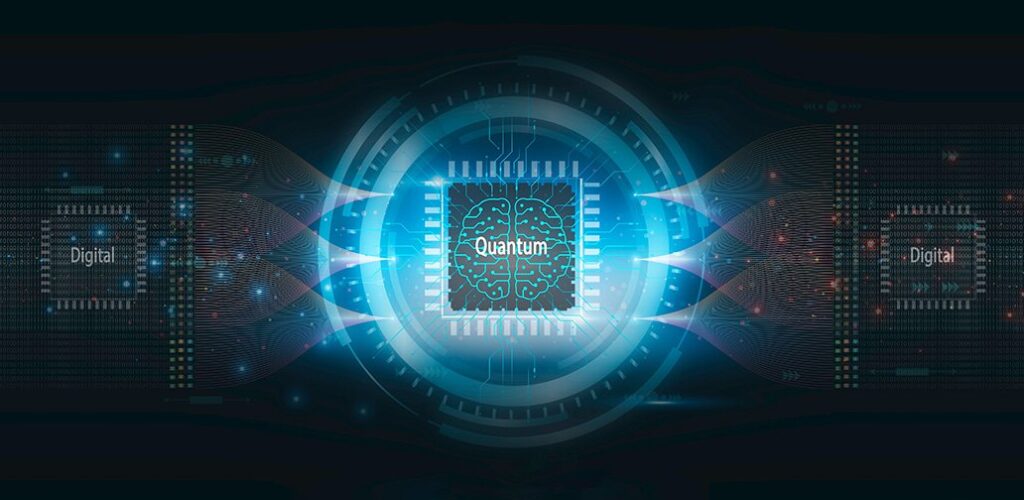
Finally, the cost and complexity of quantum infrastructure mean that widespread adoption will take time. In the near term, hybrid approaches—where classical AI works alongside quantum accelerators—are more likely than fully quantum AI systems.
Ethical and Societal Implications
If quantum computing significantly boosts AI capabilities, it could amplify both the benefits and risks of artificial intelligence.
On the positive side, quantum-enhanced AI could accelerate scientific discovery, improve healthcare outcomes, optimize energy usage, and help solve global challenges. On the negative side, it could deepen technological inequality, concentrate power among a few organizations, and raise new concerns about security and control.
As these technologies converge, responsible development will be critical. Transparency, governance, and equitable access must evolve alongside technical innovation.
What the Future May Look Like
In the short term, quantum computing will act as a specialized accelerator for specific AI tasks. In the long term, it could inspire entirely new models of intelligence that go beyond neural networks and classical learning paradigms.
Future AI systems may:
- Learn faster with fewer examples
- Solve problems once considered intractable
- Reason more holistically under uncertainty
- Operate with unprecedented efficiency
The combination of quantum computing and AI could represent a shift as profound as the transition from rule-based systems to machine learning.
Final Thoughts
Quantum computing has the potential to reshape AI at its foundations. While the technology is still emerging, its implications are vast. By unlocking new ways to process information, explore complexity, and learn from data, quantum systems could propel AI into a new era of capability.
The true impact may not be immediate, but as quantum hardware matures and algorithms evolve, the fusion of quantum computing and AI could redefine what intelligent machines are capable of—and how they help shape the future of humanity.